wash your language

  • All Posts
  • Publications
  • Services
  • Contact
  • Fairies at the Stone Circle
You are here: Home / Family / Nana’s Gingerbread

Nana’s Gingerbread

November 13, 2019 by EmmaP 2 Comments

I’ve been running a blog for a few years so maybe it’s no harm if I put up a baking recipe from time to time. I’ll warn you here, it’s no healthy, non-vegan, low-sugar snack but an old-fashioned treat that’s full of butter and sugar.

This is my mum’s gingerbread, which I decided to bake, out of the blue, last week, for the main purpose of giving the house a blast of of sticky sugar and spices for an afternoon.

When I told the kids I was making it they were sceptical. “It’s not like gingerbread cookies” I told them, as they were thinking of the Scandinavian-style cookies we often make at Christmas, in shapes of reindeer and star-jumping men, or occasionally the kind you glue together with icing sugar into a gingerbread house and later smash and eat.

This is a sticky, sugary and soft cake which has to be eaten with a cup of hot (not warm) tea. Of course, the kids loved it, and the husband, as did my workmates, and the under-12s football team after the 10am Saturday morning match. It goes a long way, this one recipe.
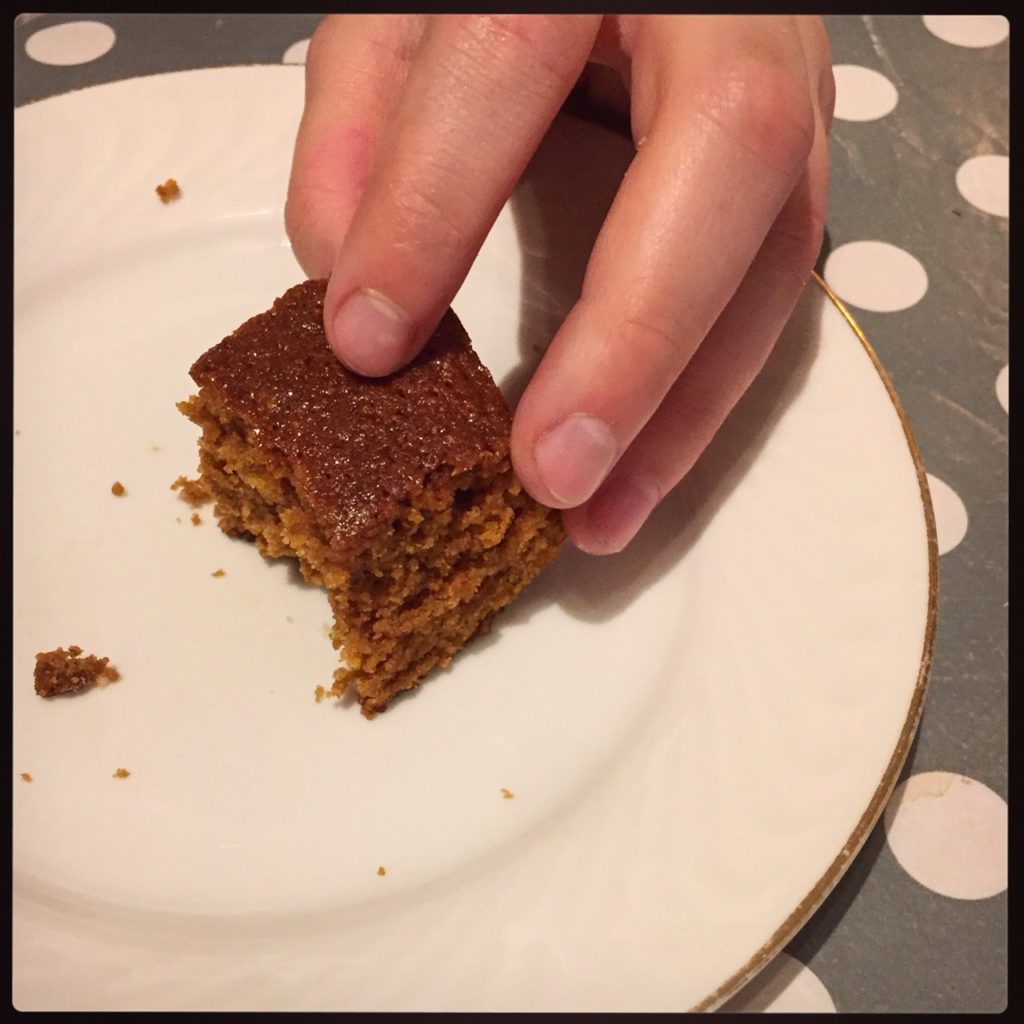
I have no idea where my mum got the recipe. I’ll never find out, as she’s been gone now over 5 years. She would have sent it to me years ago typed up in an email, the only bits of correspondence I have left from her during my many years abroad. I baked it during long winter evenings in Toronto and Nova Scotia and a few times, later on, in Oslo.

The instructions are pure Shigs (my mum’s childhood nickname, short for Sighle) – bare-boned and concise, to the point of being vague. Not for her details like size of pan, or method of combining ingredients or even length of cooking time. To be sure, I checked her handwritten recipe in her old recipe book that still sits in my Dad’s kitchen. He suggested I take it with me, but the two of us gasped at the idea.
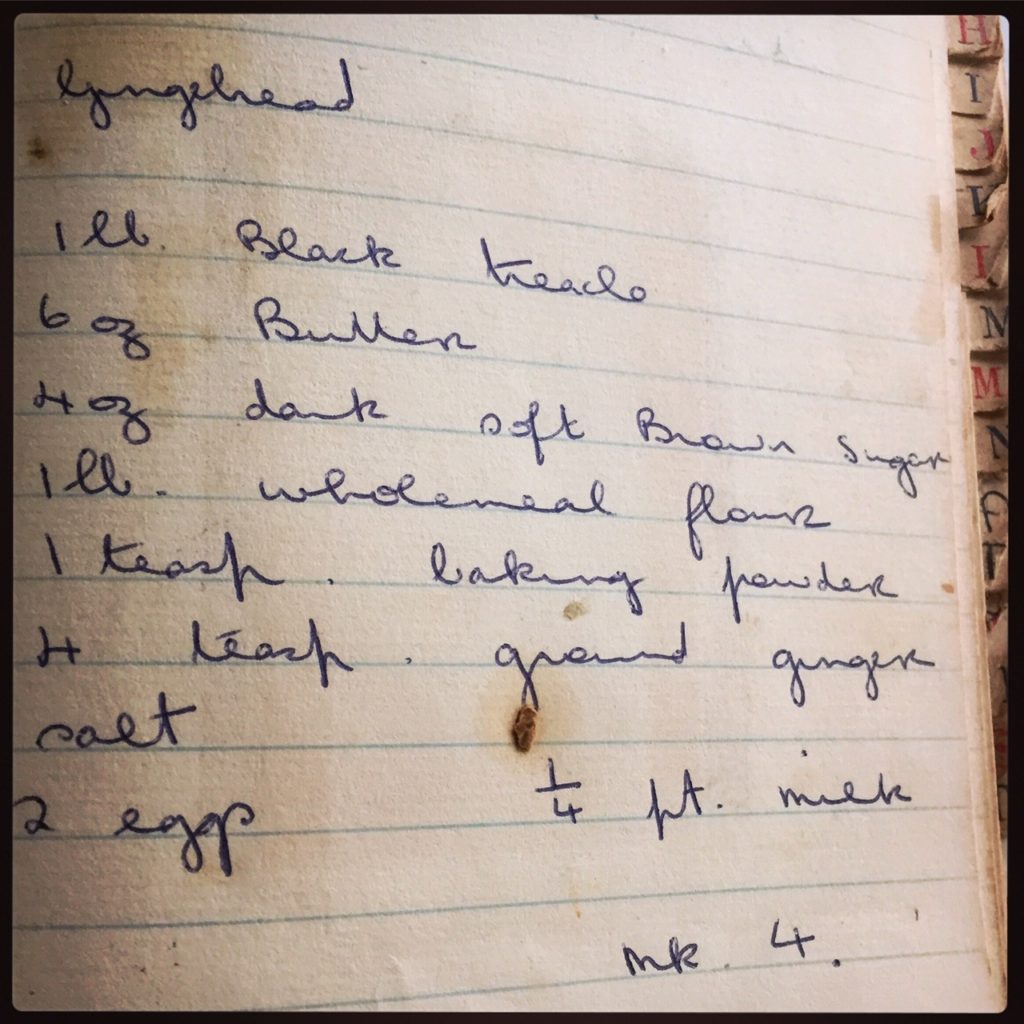
Did she get it from her own mother, who died before I was born? Most likely. But it’s just one thing on the ever-expanding list of things I’d love to ask her, as I and the kids get older, to ask her about her own experiences of health changes, perceptions of the world, of driving kids to school matches and music lessons and to their sleepovers with new friends, slowly but surely moving off into their own lives.

She might be amazed to see me writing on my own blog, and her recipe but how else can I let a recipe like this die out if I don’t share it?

Nana’s Gingerbread

Looking at the old recipe, I’ve clearly updated it over the years. My key, authentic ingredients here are the treacle and golden syrup – cans of which I would actually bring back abroad after a trip home to Dublin. Sometimes. But you can substitute molasses for the treacle and most countries have their own form of light syrup (or just use honey). Brown sugar is also hard to come by but oh is it worth it!
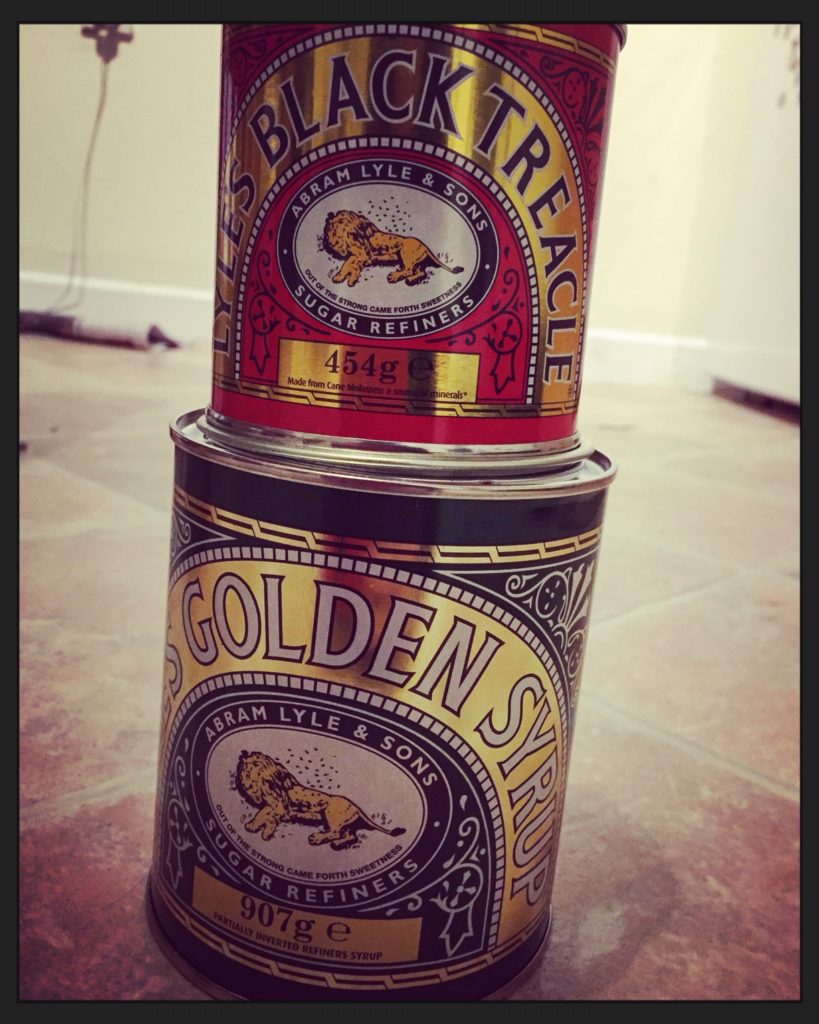
Ingredients

  • 4oz treacle
  • 4oz golden (light) syrup
  • 8oz dark brown sugar (or light brown)
  • 1/4 pint (150ml) of olive oil or 6oz butter
  • 10oz white flour and 1/2 teaspoon of baking powder
  • 2 oz wholemeal flour
  • Pinch of salt
  • 3 level teaspoons of ground ginger
  • 1/4 pint (150ml) mlik
  • 2 eggs

Method

Preheat the oven to gas mark 3, 180 degrees celsius
Line a tin 8 x 11 inches

  • Melt together in a heavy saucepan the treacle, syrup, sugar and oil (or butter) over a low heat so it doesn’t burn.
  • Mix together all the dry ingredients.
  • Beat the eggs and milk.
  • Mix the whole lot together, pour it into the pan.
  • Bake for 1 to 1-5 hours. Leave in tin to cool.
  • I have a note that says it’s better overdone than underdone, but I’m not sure about that.

Get the kettle on!

Filed Under: Family, Food, Ireland Tagged With: Baking, Gingerbread

Recent posts

  • Once Upon a Time in Boston January 7, 2024
  • The Accordion’s Tale June 29, 2023
  • Mothers on Buses July 8, 2022

Comments

  1. Margaret says

    November 19, 2019 at 10:47 am

    A lovely recipe.
    I baked a batch at the weekend, divided it into two cake tins and reduced the baking time.
    Result was lovely rich, sticky, ginger cake bars, which went down very well at my daughters day-long sports tournament.
    Definitely a keeper, thanks for sharing.

  2. EmmaP says

    November 20, 2019 at 12:15 am

    Oh I’m so delighted to hear that! And to think the recipe will live on.

Leave a Reply

Your email address will not be published. Required fields are marked *

This site uses Akismet to reduce spam. Learn how your comment data is processed.

A Blog and More

I write about language and the quirks of our family life in Dublin and previously in Italy and Norway. Read More…

RSS
Facebook
Facebook
fb-share-icon
Twitter
Visit Us
Tweet
Instagram

Instagram

Facebook

Cover for Wash Your Language
233
Wash Your Language

Wash Your Language

Musings on language and daily life in Ireland with memories from Canada, Italy and Norway

Wash Your Language

5 months ago

Wash Your Language
When you police a language ... See MoreSee Less

Using 'go' to cheer on sports teams is now OK, says Quebec language watchdog | CBC News

www.cbc.ca

Quebec's language watchdog has changed its tune on whether it's acceptable to use the word "go" to cheer on sports teams.
View on Facebook
· Share

Share on Facebook Share on Twitter Share on Linked In Share by Email

Wash Your Language

8 months ago

Wash Your Language
A few coincidences.As I walked past our local takeaway today, I spotted this manhole cover at my feet. It commemorates an event on the Dublin Easter Rising of 1916 - which was marked today, as always, on Easter Monday, 109 years later. The image shows the man who first raised the Irish Republic flags on the roof of the GPO, one of the main buildings held by the rebels that week. His name was Éamonn Bulfin, he was about 24 and along with many others, he was arrested and sentenced to death by the British authorities when the rising was quashed. But the Argentine ambassador intervened, because Éamonn was an Argentinian citizen - so he was deported instead, back to Buenos Aires. He had been born there in 1892 to 2 Irish parents who had emigrated to Argentina and had 5 kids. The family moved back to Ireland (presumably by slow boat over many weeks) when he was about 10. He went to St. Enda's School, became a fluent Irish speaker and a republican and so got involved in the Rising.After being deported back to BA after the rising, the Argentine government felt the need to arrest him for "skipping out on military service" though it was probably trying to appease the British government who they were already fighting with over the Falkland Islands. This is 1917.After 2 years in prison, Éamonn moved to Ireland again after independence, after doing a stint as the first ambassador of the new Irish state to Argentina. Why? Because Argentina absorbed tons of Irish emigrants - today it's thought 500k to 1 million Argentinians claim Irish heritage!He farmed in Offaly, wrote short stories in English and Spanish, moved to Donnybrook when he retired and after he died in 1968 (buried near Birr) a road in Inchicore was named after him.Oh and one of his sisters married Sean McBride who won the Nobel Peace Prize in 1974 for co-founding Amnesty International.And, of course today Argentina is in the news today as dear old Papa Francesco came from Buenos Aires (Italian heritage) though I also just learned that he never went back to that city after becoming pope.So that's the manhole cover that pops up in a few places around Ireland, and outside our local takeaway.(Photo from Society for Irish Latin American Studies) #EasterRising #manholecover #irishhistory ... See MoreSee Less

Photo

View on Facebook
· Share

Share on Facebook Share on Twitter Share on Linked In Share by Email

Wash Your Language

8 months ago

Wash Your Language
Time for another trip to London! ... See MoreSee Less

A revolutionary new tube map shows where London Underground trains are in real-time

www.timeout.com

See exactly where London’s tube trains are at any given time.
View on Facebook
· Share

Share on Facebook Share on Twitter Share on Linked In Share by Email

Wash Your Language

11 months ago

Wash Your Language
What Americans think will happen when they visit Ireland. Paul Mescal on SNL ... See MoreSee Less

Irish Americans - SNL

youtu.be

In this Cut for Time Sketch, an American couple (Andrew Dismukes, Ashley Padilla) visits a pub in Ireland.Saturday Night Live. Stream now on Peacock: https:/...

Video

View on Facebook
· Share

Share on Facebook Share on Twitter Share on Linked In Share by Email

Wash Your Language

12 months ago

Wash Your Language
Remembering a bone-cold, damply-quiet December visit to stunning Venice 6 years ago ... See MoreSee Less

Photo

View on Facebook
· Share

Share on Facebook Share on Twitter Share on Linked In Share by Email

Wash my language?

Språkvask is the Norwegian word for proofing text. Literally it means “language wash”; a more poetic way of saying it!

Blog comments

  • Donna on The Wall of Pink Covid Hearts
  • EmmaP on Tunes in an Empty Pub
  • Cathy Hogan on Tunes in an Empty Pub

© 2025 · Handcrafted with d by 2 Pups Design Co.